The record everything else hangs from
Every matter, in order.
Keep case details, parties, hearing dates and assignments together. Connect the matter to the time, expenses, documents and bills that belong to it.
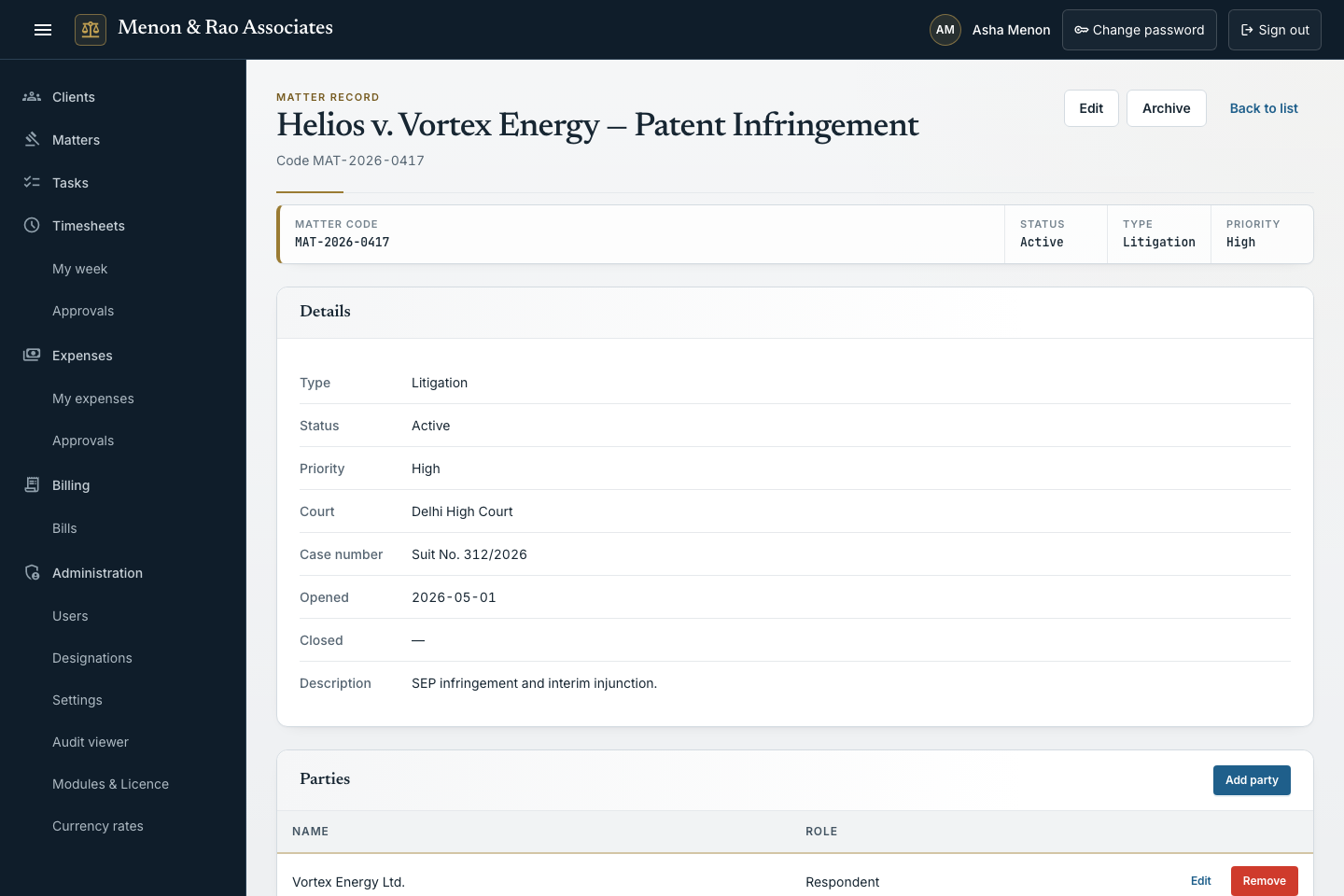
What a matter has to hold
Fields litigation actually uses.
Most systems arrive with a generic engagement record — a name, a client, a status — and expect a firm to keep the rest in the description. That works until somebody asks which matters have a hearing next week.
- Matter type, from a list the firm maintains.
- Court and case number, so a matter can be found the way it is referred to in conversation.
- Opposing party, recorded for reference; automated conflict checking is not included.
- Hearing dates, entered by your team as dates. Automatic court-status retrieval is not included.
- Status and priority, from lists the firm controls, not fixed choices.
The client record behind it carries contacts, departments and billing entities, along with the two things billing needs to know before it can issue anything: the client’s GST treatment and whether they withhold TDS.
Court, case number, opposing party, hearing date. Fields — not free text in a description.
Work broken into pieces that can be priced
Tasks are how fee arrangements get specific.
A task catalogue is maintained by the firm, and tasks are assigned on a matter with an assignee, a supervisor and a due date. Time is then recorded against the task rather than against the matter as a whole.
This is not administrative tidiness. It is what makes a hybrid fee arrangement possible: "drafting and settling the plaint" carries a fixed amount, everything else is charged at the designation rate of whoever did it, and a single fee note shows both. Without task-level recording, that arrangement has to be reassembled by hand every month.
A matter has a life, and an end
Events, not manual tidying.
Modules in AntChambers do not reach into each other’s data. They publish events and react to them, which is what allows a module to be switched off entirely without leaving the rest of the system broken.
Archiving a matter publishes an event. Timekeeping stops offering it for new entries, billing understands the engagement has ended, and the record and its history remain intact and searchable. Nothing is deleted, because in a professional practice the closed file is the one you are most likely to be asked about.
Questions this raises
Straight answers.
Why call it a matter and not a project?
Because that is what it is called in practice, and because the fields differ. A matter has a court, a case number, an opposing party and hearing dates. A project has a deadline and a budget. Naming it correctly is not cosmetic — it decides what the record can hold.
Can we define our own matter types and statuses?
Yes. Status, priority and matter type are lists the firm manages from the admin screens rather than choices fixed in the code. One firm’s "under advice" is another firm’s "opinion pending" and both are correct.
How are tasks handled?
There is a task catalogue the firm maintains, and assignments made against a matter with an assignee, a supervisor and a due date. Time is recorded against the task, which is what lets a hybrid fee arrangement price named tasks at a fixed amount.
What happens when a matter is archived?
Archiving preserves the matter record as historical work. Agree how open assignments, time and billing will be completed before archiving; data retention and eventual deletion follow the signed agreement.
Can one client have several billing entities?
Yes — a client can carry more than one billing entity, which is what consortium and group-company arrangements need when the work is one relationship but the invoices go to different companies.
Where to read next
Related
- Documents
The papers that belong to the matter.
- Timekeeping
Hours recorded against matters and tasks.
- Billing
Terms of engagement per client and matter.
See how it fits your practice
A working demo takes about forty minutes. We use sample or anonymised matters, timesheets and fee notes to walk through your workflow. Please do not share confidential client information.