Tax lines, SAC codes and the treatment that varies by client
Tax settings that follow the engagement.
Configure GST treatment, SAC codes and invoice details. Record TDS withholding alongside receipts so the outstanding balance reflects what is still owed.
Where generic invoicing breaks
One firm, four kinds of client.
A firm of any size ends up issuing four materially different invoices in the same month, and the difference is a property of the client rather than of the work:
- A domestic business client under regular GST. Tax collected on the invoice, split into CGST and SGST or charged as IGST depending on where the supply lands.
- A business client under reverse charge. The supply is shown, the tax is not collected, and the invoice carries the declaration that the recipient is liable to pay it.
- An overseas client. Export treatment, no domestic tax lines, often billed in another currency.
- An exempt engagement. No tax, and an invoice heading that does not claim to be a tax invoice.
Software that offers one invoice template and a tax percentage handles the first case and forces a workaround for the other three — usually a second template kept in Word, which is where invoice series start developing gaps.
How the treatment reaches the invoice
Set it on the client once.
GST treatment and TDS applicability are recorded against the client, and every bill raised for that client follows them without anybody remembering to. The invoice adapts as a document, not only as a number:
- The heading changes when the supply is not a taxable one.
- The GSTIN block appears, or does not, according to registration and treatment.
- Tax lines carry the SAC code, and are split correctly for the place of supply.
- Rounding is applied once, in a configured way, and the total agrees with the sum of its parts.
The whole apparatus can also be switched off at installation level for a firm that is not registered — the fields disappear rather than sitting empty.
Tax invoice
AC/2026-27/0184
| Particulars | Rate basis | Hours | Amount ₹ |
|---|---|---|---|
| Drafting and settling written statement | Partner | 6.5 | 117,000 |
| Conference with client and instructing solicitor | Partner | 2.0 | 36,000 |
| Research on limitation and amendment | Associate | 11.5 | 74,750 |
| Appearance — NCLT, Mumbai (26 & 27 Aug) | Fixed fee | — | 90,000 |
| Professional fees | 317,750 | ||
| Disbursements (travel, filing, court fees) | 14,300 | ||
| CGST @ 9% | 29,884 | ||
| SGST @ 9% | 29,884 | ||
| Invoice total | 391,818 | ||
| Less TDS @ 10% u/s 194J (withheld by client) | −31,775 | ||
| Expected receipt | 360,043 | ||
One firm issues four materially different invoices in the same month.
After the invoice
TDS is part of billing, not part of accounts.
Tax withheld by the client is the reason an invoice and a bank credit almost never match. If a billing system cannot record it, every corporate client appears to be in arrears by exactly the withheld amount, and the collections conversation becomes an argument about arithmetic.
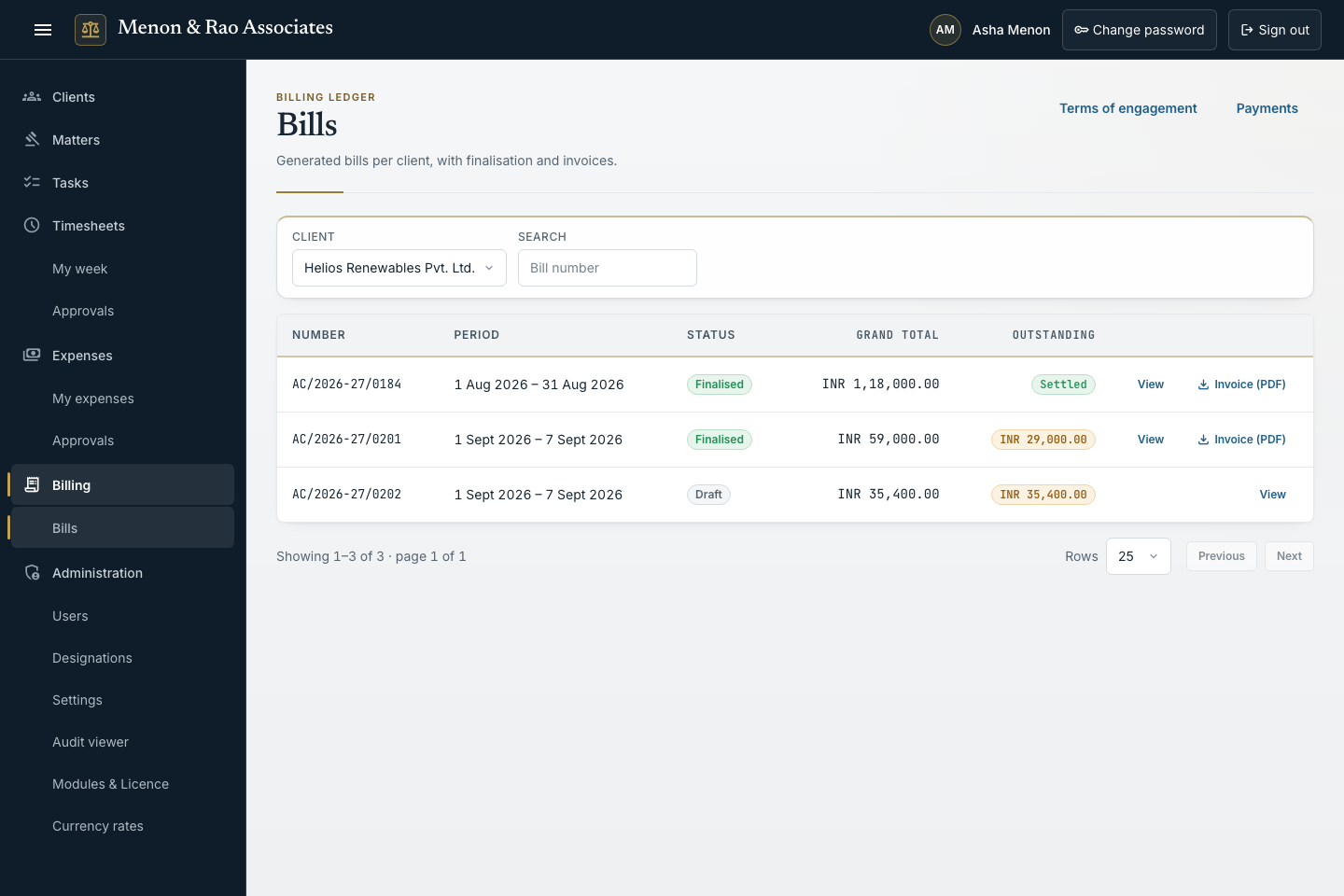
AntChambers records the receipt with the deduction against the bill. The bill closes when the expected amount has arrived; the withheld tax is held, visible, and available for the certificate that follows. What the outstanding report shows is money you are genuinely waiting for.
AntChambers records the treatment you set and computes accordingly. It does not give tax advice, and the decision about which treatment applies remains yours and your adviser’s.
Questions this raises
Straight answers.
Which SAC code applies to legal services?
Legal services are generally billed under SAC 998216. The code sits on the tax line rather than being typed into a description, and it can be set where a particular service needs a different one. Confirm the code with your own tax adviser — the software records what you decide, it does not decide for you.
How is reverse charge handled?
It is a per-client treatment. Where legal services to a business are taxed under reverse charge, the invoice shows the supply without collecting the tax and carries the declaration that the recipient is liable. You set the treatment on the client once; every bill for that client follows it.
Can we bill an overseas client without GST?
Yes — export treatment issues the invoice without domestic tax lines and adapts the heading accordingly. Billing in the client’s currency is supported at the same time.
What if the firm is not GST registered?
GST registration is an installation-level switch. With it off, GSTIN fields are hidden throughout, invoices carry no tax lines and the heading changes to suit. Registering later is a setting change, not a reimplementation.
Does it file our GST returns?
No. It produces correct invoices and the data behind them, and exports what your accountant or return-filing software needs. Filing stays with the people who are responsible for it.
How is rounding handled?
Rounding is configurable and applied in one place. Amounts are stored to two decimal places with a currency code and all arithmetic runs through a single tested money type, so a tax line, a bill total and a ledger entry cannot disagree by a paisa.
Where to read next
Related
- Billing end to end
Terms of engagement through to receipts.
- Built for Indian firms
TDS, financial years, and Indian number formatting.
- Retainers
Advances, drawdown and low-balance alerts.
See how it fits your practice
A working demo takes about forty minutes. We use sample or anonymised matters, timesheets and fee notes to walk through your workflow. Please do not share confidential client information.