Recorded, approved, locked — then billable
A clear record of the working week.
Record time in blocks, check overlaps and review submissions. Approved entries stay locked and ready for billing.
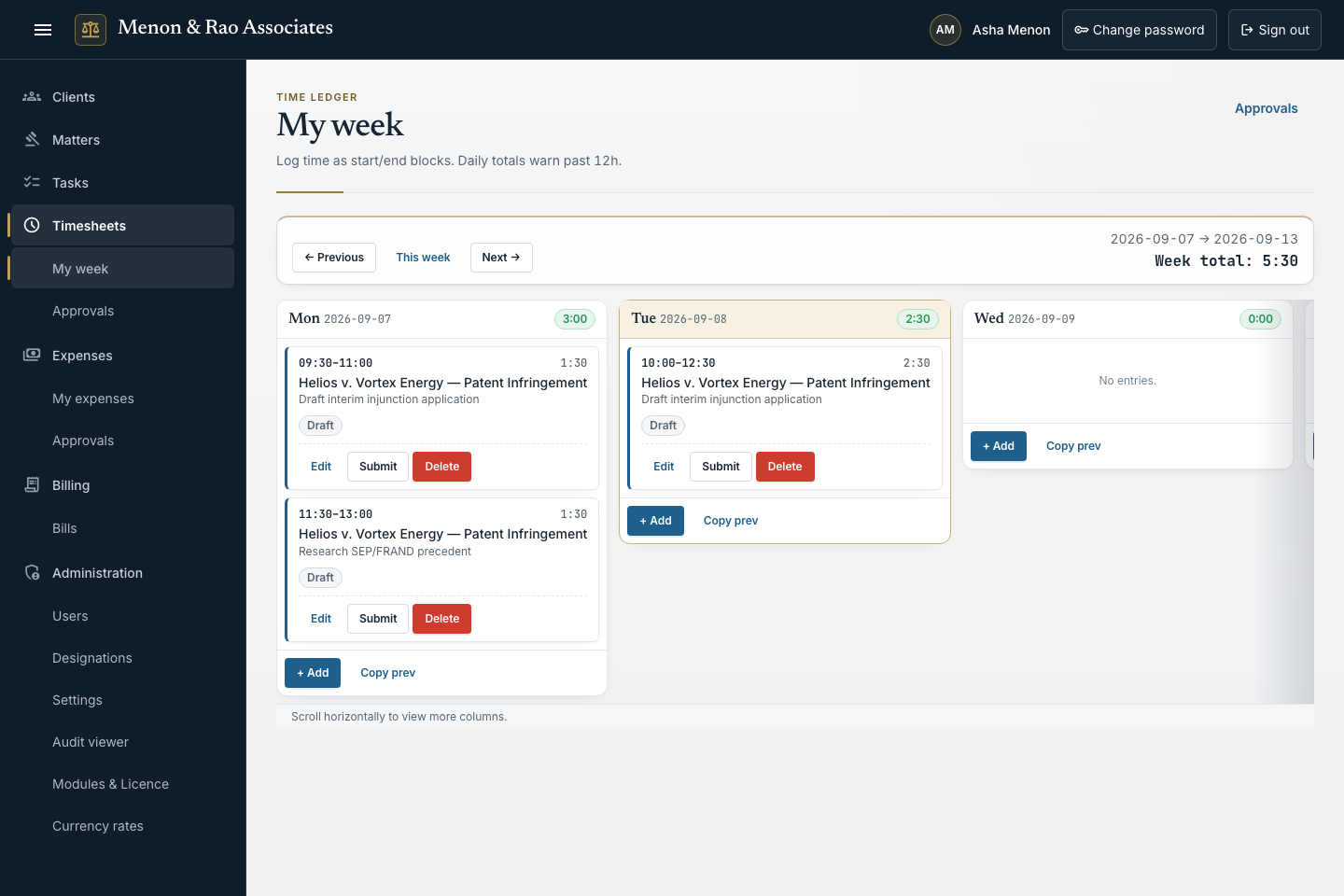
How a week gets recorded
Blocks of time, not a form.
Time is entered as start and end blocks against a matter and a task, laid out across the seven days of the week, because that is how people reconstruct one. A form that demands a single entry at a time, each with its own save, is the most reliable way to make a fee earner postpone timekeeping until Friday and then until never.
- Overlaps are refused at entry. Two entries covering the same clock time are flagged where they are typed.
- Late entries stay visible. Nothing is hidden and nothing is auto-corrected; the supervisor can see what was recorded when.
- Reminders run on your schedule. A job chases missing time at a time the firm sets, not at a time somebody in another country decided was reasonable.
My week
24 – 30 August 2026
Week total 28:00
- Mon 246:30
09:30–13:003:30
Mehta v. Union of India
Drafting
approved
14:00–17:003:00
Ravi Estates
Review
approved
- Tue 255:00
10:00–12:002:00
Mehta v. Union of India
Conference
approved
15:00–18:003:00
Ravi Estates
Due diligence
submitted
- Wed 267:30
10:30–14:304:00
Sundaram Textiles — NCLT
Appearance
submitted
14:00–15:301:30
Mehta v. Union of India
Research
overlaps 14:00–14:30
16:00–18:002:00
Ravi Estates
Review
draft
- Thu 274:00
11:00–15:004:00
Sundaram Textiles — NCLT
Appearance
submitted
- Fri 285:00
09:30–12:303:00
Mehta v. Union of India
Drafting
draft
14:00–16:002:00
Ravi Estates
Review
draft
- Sat 290:00
No entries
- Sun 300:00
No entries
Approval is the line between what somebody typed and what the firm is prepared to charge for.
What approval is for
Approval is a boundary, not a formality.
Approval exists for one reason: to draw a line between what somebody typed and what the firm is prepared to charge for. Once an entry is approved it is locked, and only locked entries are visible to billing.
That boundary is enforced in the software rather than in a procedure note. It is also the fix for a specific failure the previous system had — bills that occasionally picked up entries from an earlier period, because nothing prevented it. Here the period selection and the approval state are both part of what makes an entry eligible, and both are tested.
Who sees what
Recording, approving and viewing others’ time are separate permissions. A supervisor approving a team’s week, a partner reviewing a matter, and an associate seeing only their own entries are three different grants of the same module.
What it is worth in practice
What changes in the first month.
Firms coming from spreadsheets usually notice three things quickly. Someone stops spending a week a month consolidating sheets. The question "what is August worth" gets answered on the 1st of September instead of the 10th. And the arguments about whether a matter is profitable become arguments about numbers everyone can see, which is a much shorter kind of argument.
Questions this raises
Straight answers.
How do people actually enter time?
As start and end blocks against a matter and a task, laid out across the seven days of the week. It is built for the way most fee earners work — sitting down once or twice a week and reconstructing it — rather than assuming everyone runs a live timer.
What is overlap validation?
Two entries by the same person covering the same clock time cannot both be right. The grid catches it at entry and refuses the submission until it is corrected, which is far cheaper than finding it during a billing run.
Who approves time, and what does approval change?
Approval is a permission, usually held by supervisors and partners, and there is a queue for it. Approval locks the entry — it can no longer be edited — and locking is what makes an entry eligible for billing.
Can we stop people back-dating entries?
Late entries are visible rather than hidden, and a reminder job chases missing time on a schedule the firm sets. What to do about a lawyer who fills in three weeks at once stays a management decision; the software makes sure it is not a secret.
Does unapproved time show up on a bill?
Never. Billing draws only from approved entries, by design. This was a deliberate change from the system AntChambers replaced, where the boundary was not enforced and bills occasionally collected old entries.
Where to read next
Related
- Billing
What approved hours turn into.
- Matters and tasks
What time is recorded against.
- The whole product
How timekeeping fits the rest.
See how it fits your practice
A working demo takes about forty minutes. We use sample or anonymised matters, timesheets and fee notes to walk through your workflow. Please do not share confidential client information.