One application for matters, time, money and records
Your practice, connected.
Open matters, record time, capture expenses and bill under agreed terms. One application, with all standard modules included and a private instance managed for your firm.
What a practice actually has to run
The whole chain, in one place.
Most firms do not lack software. They have a spreadsheet for time, a Word template for bills, a folder tree for documents, and a partner who keeps the outstanding position in their head. Each part works. The joins do not.
AntChambers is built as one chain with no manual joins in it:
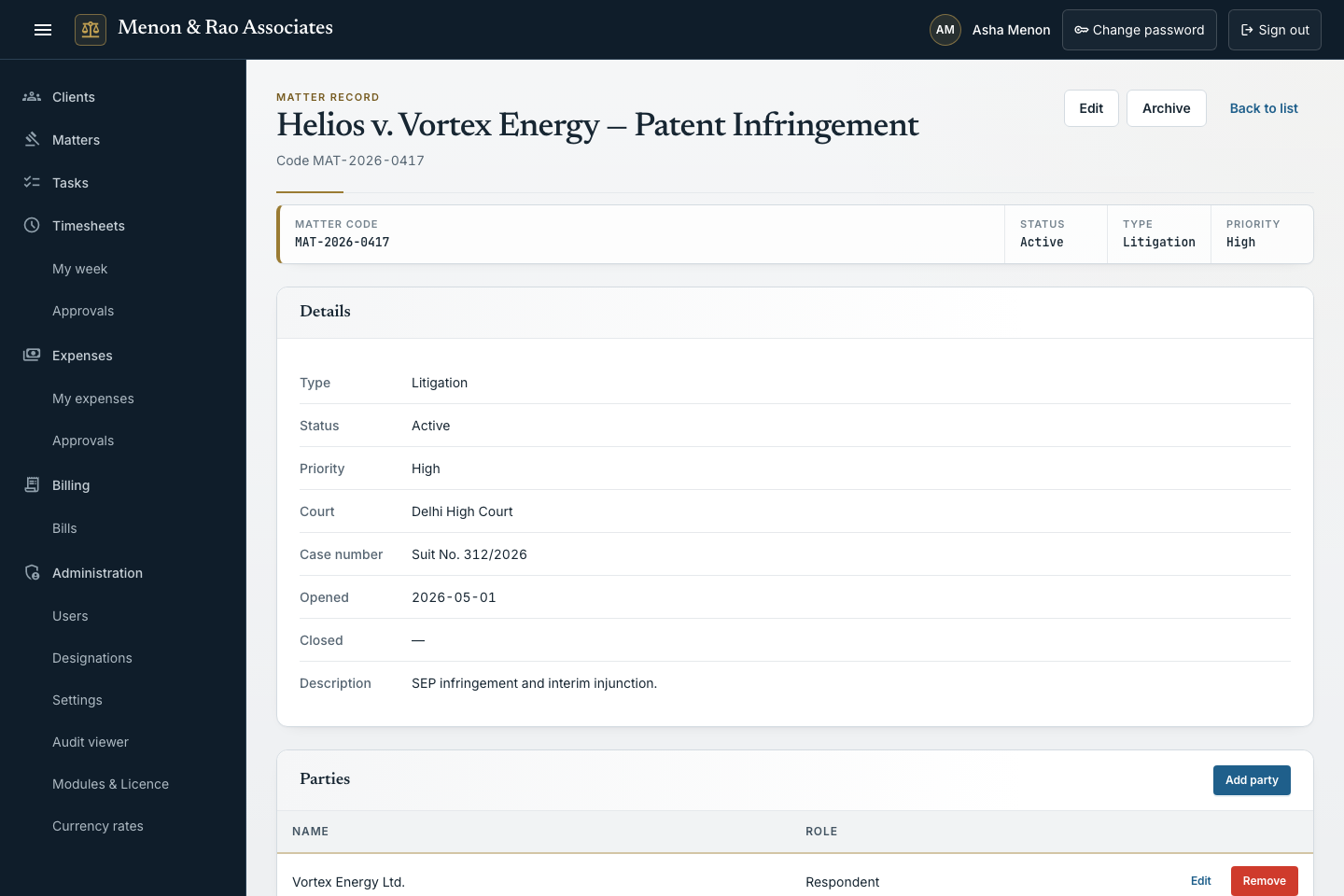
- A matter is opened against a client, with the court, case number, opposing party and hearing dates that litigation actually needs.
- Terms of engagement are agreed — fixed, hourly, or hybrid with rates by designation and fixed amounts for named tasks.
- Time is recorded as start and end blocks across the week, refusing overlaps and locking once approved.
- Disbursements are captured with the receipt attached and a billable flag, and go through their own approval.
- A bill is raised for a period from approved time and approved disbursements only, priced by the terms, taxed under the client's GST treatment, and numbered by financial year.
- A receipt is recorded net of TDS, so the outstanding figure is the money you are actually waiting for.
Nothing in that chain is retyped, and every figure at the end can be traced back to the hour that produced it.
One chain, with no manual joins left in it.
Everything in one subscription
All standard modules, configured for your firm.
Core is present in every private instance and is not separately priced: people and designations, granular permissions, firm branding and settings, a complete audit trail, notifications, file storage, currency handling, and the module and subscription manager itself.
Clients, Matters, Tasks, Timesheets, Expenses, Billing, Retainer, Documents and Reports are all included. We configure the workflows your firm needs; activating an included module later carries no additional module fee.
Core
IncludedUsers, designations, permissions, firm branding, settings, audit trail, notifications and file storage. Present in every private instance.
Clients
IncludedClient master with contacts and billing entities, per-client GST treatment and TDS applicability.
Read more about ClientsMatters
IncludedMatter type, court, case number, opposing party and hearing dates — with configurable status and priority lists.
Read more about MattersTasks
IncludedA task catalogue plus per-matter assignments with assignee, supervisor and due dates.
Timesheets
IncludedWeekly entry grid with overlap validation, an approval queue, entries that lock once approved, and a reminder job.
Read more about TimesheetsExpenses
IncludedDisbursement capture with receipt attachments, a billable flag and an approval queue.
Billing
IncludedTerms of engagement, bills raised from approved time and expenses, GST, TDS-aware receipts, FY numbering, PDF and DOCX invoices.
Read more about BillingRetainer
IncludedPre-paid wallets per client or matter, a full ledger, replenishment on finalised bills and a low-balance scan.
Read more about RetainerDocuments
IncludedA central document store per client and matter with versioning and permission-aware access.
Read more about DocumentsReports
IncludedA parameterised report runner with Excel and PDF export and scheduled email delivery. Modules contribute their own reports.
Who it suits, and who it does not
Fit.
It fits firms that
- Bill by time, or by a mix of time and fixed fees, and argue about rates by seniority.
- Have clients who withhold TDS and expect a GST invoice with a SAC code.
- Take money on account and need a retainer ledger rather than a note in a file.
- Want a private system for confidentiality or client mandate without operating the infrastructure themselves.
It does not fit firms that
- Work purely on contingency with no time recording at all.
- Want a public app marketplace with third-party plug-ins — modules here are ours, scoped per firm.
- Need offline operation. The standard offer is a managed private service; customer-hosted deployments require a separate scope and quote.
Bringing a firm live
Four steps.
Scope the private instance
We confirm firm size, modules, data and backup region, retention needs and the address people will use.
Provision with your branding
AntChambers creates the isolated application, database, document store and backups, then applies firm name, logo, GSTIN, financial-year convention and timezone.
Import what you already have
One template-based import of up to 1,000 combined client and matter records is included. Historical time, bills, document archives and data cleanup need a separate fixed quote.
Go live one module at a time
Setup includes two one-hour remote training sessions. Agree a rollout sequence with your team; all standard modules remain included, with no later activation fee.
Questions this raises
Straight answers.
What does law firm management software need to do that generic project software cannot?
Three things. It has to record time in a way that survives an audit — approved, locked, attributable. It has to turn that time into a fee note under terms of engagement that vary by client, matter, designation and task. And it has to reconcile what was invoiced with what was received after the client withheld TDS. Check these workflows during evaluation rather than assuming a generic task tracker covers them.
How many people does a firm need before this makes sense?
The standard plan includes five named active users across all roles. Smaller firms can use the same plan; the right fit depends on your billing workflow and the cost of managing it today. Additional users are priced individually up to 25, with larger teams quoted separately.
Does it replace accounting software?
No. AntChambers owns everything up to the invoice and the receipt against it — terms, time, disbursements, tax lines, outstanding balances. Your books stay in your accounting package, and the invoice data is exported to it.
What happens when we outgrow the original capacity?
AntChambers can increase capacity within the firm’s private deployment boundary without moving the records into a shared tenant database. The sizing and change plan are reviewed with the firm before the upgrade.
Where to read next
Related
- Billing and fee notes
Terms of engagement, bill generation, invoices, receipts.
- Timekeeping
Weekly grid, overlap checks, approvals that lock.
- Deployment and security
Where it runs, who can reach it, and how it is operated.
- Pricing
How a managed private-instance subscription is put together.
See how it fits your practice
A working demo takes about forty minutes. We use sample or anonymised matters, timesheets and fee notes to walk through your workflow. Please do not share confidential client information.