Terms of engagement, through to money received
From approved work to the fee note.
Apply fixed, hourly or hybrid engagement terms. Raise invoices from approved work and expenses, then track receipts and TDS withholding.
What the engine has to model
Terms first. Everything follows from them.
A fee note is only correct if the terms behind it are modelled properly, so terms of engagement are a first-class record held per client and per matter, not a rate typed onto an invoice.
- Fixed. An agreed amount for the engagement or for a stage of it.
- Hourly. Rates that differ by designation, so a partner’s hour and an associate’s hour price themselves.
- Hybrid. Named tasks carry a fixed amount; everything else falls through to the designation rate. This is what most real engagements look like, and it is the case generic billing tools handle worst.
Rates are dated, so changing a rate card next April does not silently reprice work already recorded under the old one.
How a month becomes a bill
Raised from approved work only.
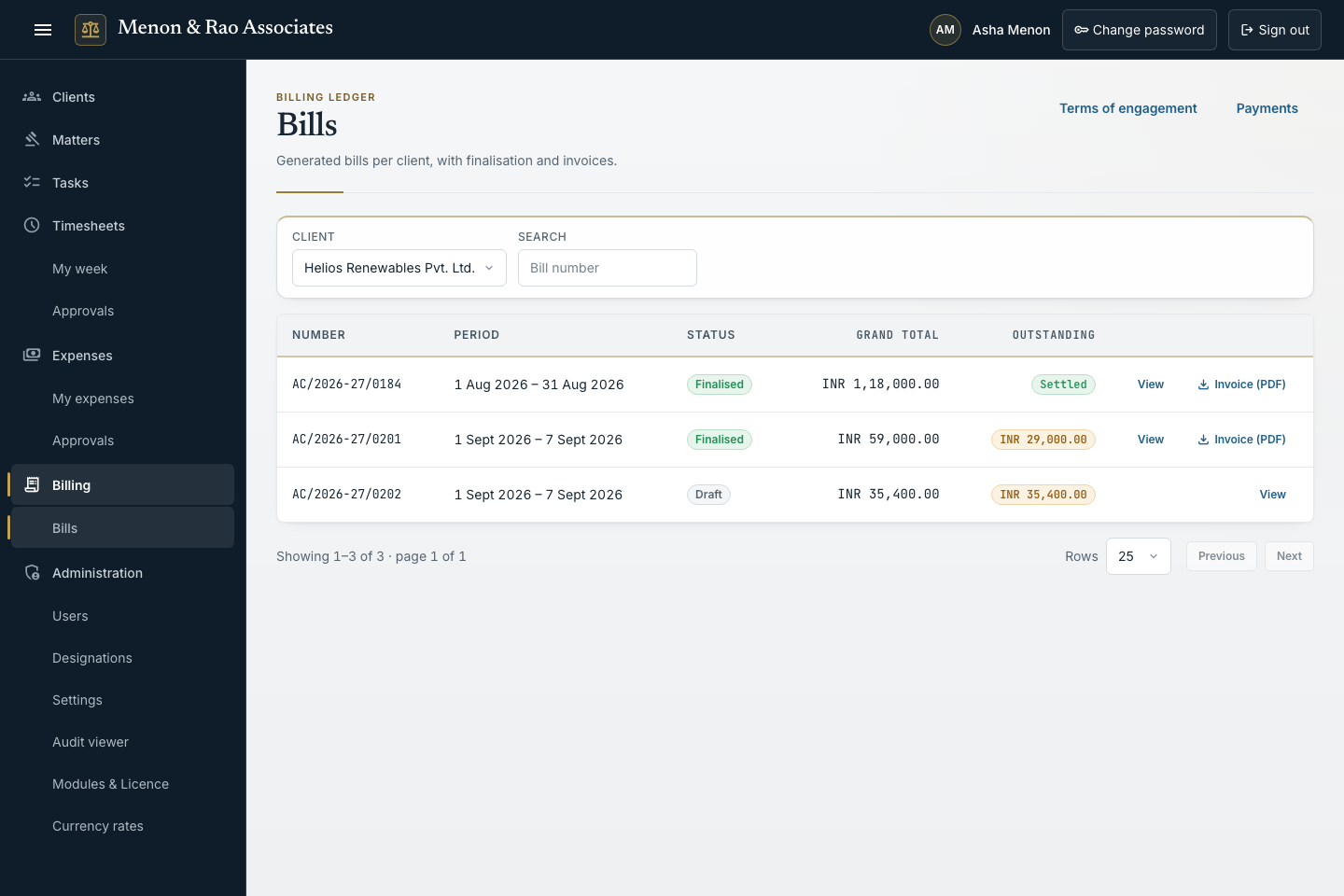
A bill is generated for a client or matter across a period. It draws only from timesheet entries that have been approved and disbursements that have been approved and marked billable. Unapproved work is invisible to billing, which removes the most common cause of a bill going out wrong.
Review the generated draft before finalising. Its financial-year number is assigned when the draft is created. Finalisation locks the invoice figures and triggers downstream processing, including document rendering and retainer drawdown. Confirm any adjustment workflow you need during evaluation.
Tax invoice
AC/2026-27/0184
| Particulars | Rate basis | Hours | Amount ₹ |
|---|---|---|---|
| Drafting and settling written statement | Partner | 6.5 | 117,000 |
| Conference with client and instructing solicitor | Partner | 2.0 | 36,000 |
| Research on limitation and amendment | Associate | 11.5 | 74,750 |
| Appearance — NCLT, Mumbai (26 & 27 Aug) | Fixed fee | — | 90,000 |
| Professional fees | 317,750 | ||
| Disbursements (travel, filing, court fees) | 14,300 | ||
| CGST @ 9% | 29,884 | ||
| SGST @ 9% | 29,884 | ||
| Invoice total | 391,818 | ||
| Less TDS @ 10% u/s 194J (withheld by client) | −31,775 | ||
| Expected receipt | 360,043 | ||
A fee note is only correct if the terms behind it are modelled properly.
Tax, withholding and the number on the cheque
The gap between invoiced and received.
An Indian fee note rarely gets paid at its face value. GST is added, the client withholds TDS under section 194J, and the amount that lands is neither figure. Billing systems that model only "invoice total" leave every corporate client looking permanently in arrears.
- GST is computed per line with a SAC code, under the treatment set for that client — regular, reverse charge, export or exempt.
- Receipts are recorded net of TDS, with the withheld amount held against the bill rather than written off.
- A bill closes when the expected receipt has arrived, so the outstanding report is the collection list.
- Part payments and allocation across several bills are supported, because clients settle in round numbers.
Numbering, documents and what survives an audit
The paper trail.
Bill numbers are issued in a financial-year series with a prefix the firm chooses. Drafts also receive numbers, so review draft and issued records together when reconciling the series.
Finalised invoices can be rendered to PDF and DOCX, with stored document versions. If the document is re-rendered — a corrected address, a new logo — the earlier copy is kept rather than replaced. Underneath, every change to every record carries who made it and when, captured at the data layer rather than by remembering to log it, and exportable as CSV when somebody asks.
Questions this raises
Straight answers.
Can a single matter be billed partly on hours and partly on a fixed fee?
Yes — that is the hybrid arrangement. Named tasks carry a fixed amount, everything else is priced by the designation rate of whoever did the work, and both appear on the same fee note.
What stops a bill picking up time that should not be on it?
Only approved entries are eligible, and an approved entry locks. A bill draws from a stated period, and once it is finalised the entries it consumed cannot be silently reused by the next bill.
Can we edit a bill after issuing it?
A draft can be changed freely. A finalised bill is write-once — it keeps its number, its figures and the rendered document. If it genuinely has to change, the correction is made as a new document and the original stays where it was, which is what an audit expects.
What do the invoices look like?
They are rendered to PDF and to DOCX from your firm’s format, carrying your name, logo, address and GSTIN, and stored immutably against the bill. Re-rendering keeps the earlier copies rather than replacing them.
How do we know what is outstanding?
Receipts are recorded against bills, net of any TDS the client withheld, so a bill is closed when the money actually expected has arrived. The outstanding figure is a fact rather than an estimate.
Can bills be raised in a currency other than the rupee?
Yes. An engagement can be billed in the client’s currency and consolidated to the firm’s base currency for reporting.
Where to read next
Related
- GST invoicing
SAC codes, reverse charge, exports and exempt supply.
- Retainers
Money on account, drawn down by finalised bills.
- Timekeeping
Where every billed line begins.
See how it fits your practice
A working demo takes about forty minutes. We use sample or anonymised matters, timesheets and fee notes to walk through your workflow. Please do not share confidential client information.