Money on account, accounted for
Keep money on account accounted for.
Track client and matter retainers through a ledger of receipts and drawdowns. Review balances and low-balance alerts alongside billing.
What a retainer needs to be
A balance with a history behind it.
A retainer is not a number on a client record. It is an opening advance, a series of drawdowns, and a balance that has to be defensible when the client asks — often a year later, often in the same conversation as a fee dispute.
- A wallet per client or per matter, whichever the arrangement calls for.
- A full transaction ledger — every advance and every drawdown, with the bill reference that caused it.
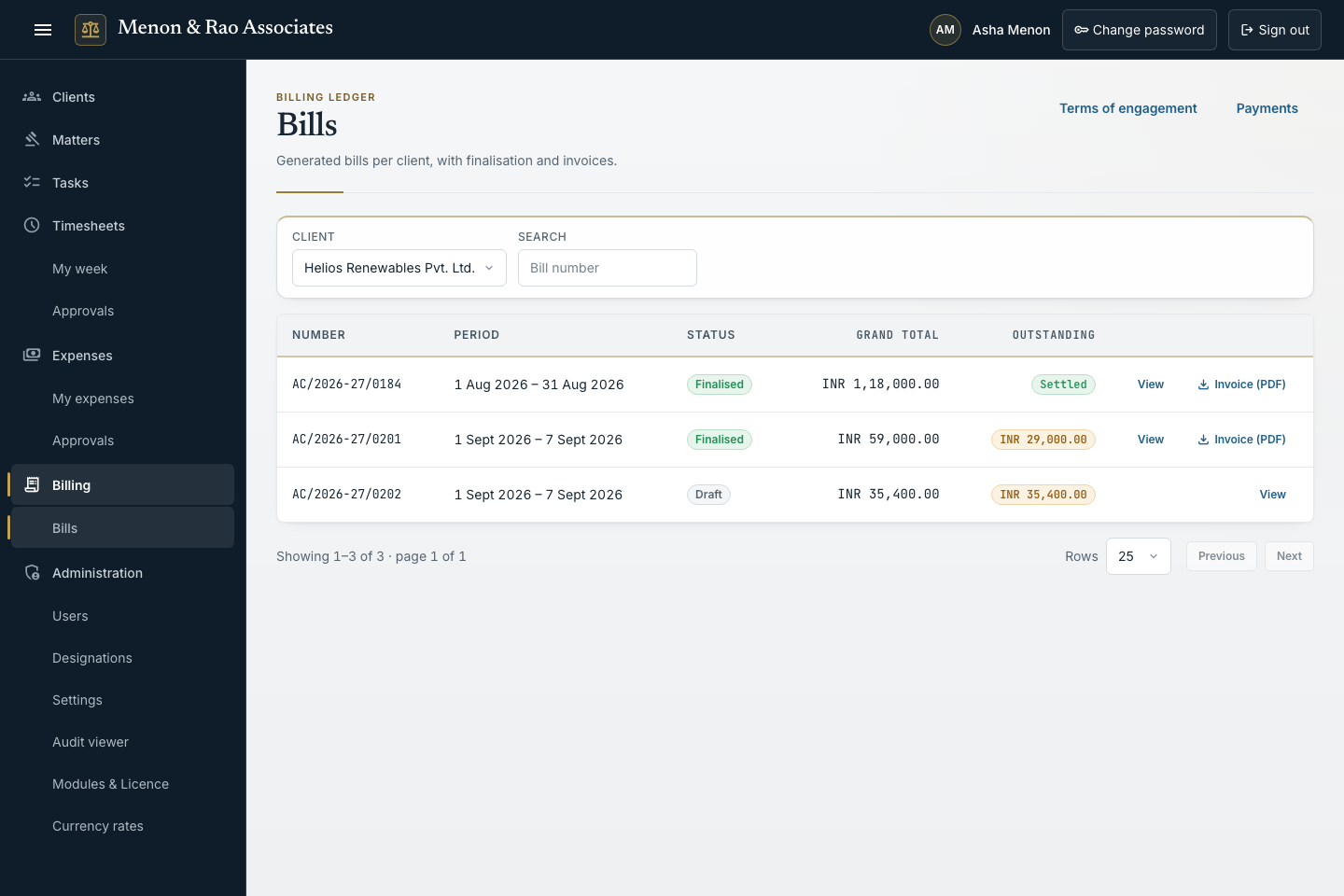
- Automatic drawdown. Finalising a bill draws the wallet down, because the bill was issued, not because somebody remembered.
- A low-balance scan that runs on a schedule and raises an alert before the balance is gone.
- Configurable replenishment. The multiplier is a setting; the system replaced by AntChambers had it fixed at twice the outstanding, which suited exactly one firm.
Retainer wallet
Sundaram Textiles — NCLT proceedings
Balance
₹1,97,332
| Date | Particulars | In ₹ | Out ₹ | Balance ₹ |
|---|---|---|---|---|
| 02 Jun 2026 | Advance received — NEFTRCPT/2026-27/0031 | 1,500,000 | — | 1,500,000 |
| 30 Jun 2026 | Bill drawn downAC/2026-27/0102 | — | 412,600 | 1,087,400 |
| 31 Jul 2026 | Bill drawn downAC/2026-27/0141 | — | 498,250 | 589,150 |
| 31 Aug 2026 | Bill drawn downAC/2026-27/0184 | — | 391,818 | 197,332 |
Balance below the threshold set for this wallet — replenishment raised
The common way retainers go wrong is not fraud. It is lag.
Why the drawdown must be automatic
The failure this prevents.
The common way retainers go wrong is not fraud, it is lag. A bill is issued, the drawdown is recorded a fortnight later or not at all, and in the meantime the balance shown is money that has already been earned. Two or three cycles of that and the firm is either asking a client to top up when they need not, or working against an advance that was exhausted a month ago.
Tying the drawdown to the act of finalising a bill removes the gap. The wallet and the bill cannot disagree, because one is a consequence of the other.
Questions this raises
Straight answers.
Is a retainer wallet held per client or per matter?
Either. A general retainer sits against the client; a matter-specific advance sits against the matter. Both keep their own ledger and their own balance.
How does a bill draw down the balance?
Finalising a bill publishes an event that the Retainer module reacts to, so the drawdown happens because the bill was issued rather than because somebody remembered to record it.
What triggers a replenishment request?
A scheduled scan checks balances against the threshold set for each wallet and raises an alert when one falls below it. The replenishment multiplier is configurable, so the amount requested reflects your arrangement rather than a fixed rule.
Can we see where the money went?
That is what the ledger is. Every advance, every drawdown and the bill reference behind it, in date order, with a running balance.
Do we need the Billing module to use retainers?
Yes. Retainers exist to be drawn down by bills, so Billing is a prerequisite. Billing and Retainer are both included in the standard subscription. Firms that do not take money on account can leave the retainer workflow disabled.
Where to read next
Related
- Billing
What draws the wallet down.
- GST invoicing
How the bills behind the drawdown are taxed.
- All modules
What else can be switched on.
See how it fits your practice
A working demo takes about forty minutes. We use sample or anonymised matters, timesheets and fee notes to walk through your workflow. Please do not share confidential client information.