Indian practice by default, never by assumption
Built around Indian legal practice.
GST and TDS-aware billing, financial-year numbering and Indian currency formatting, in a private instance managed for your firm.
What localisation usually misses
Indian defaults, not Indian assumptions.
There is a difference between software that can be made to work in India and software that was designed for it. The difference shows up in the awkward cases — the client who deducts tax at source, the matter billed under reverse charge, the invoice series that has to restart on 1 April.
GST that behaves like GST
Tax lines carry a SAC code. Treatment is set per client — regular, reverse charge, export or exempt — and the invoice adapts, including the heading and the GSTIN block, when the supply is not taxed. Rounding is configurable rather than assumed. If the firm is not registered, the whole apparatus disappears behind one switch.
TDS that reaches the ledger
A corporate client withholds tax under section 194J and pays you less than the invoice. Software that cannot record this leaves every such bill looking part paid forever. AntChambers records the receipt with the deduction, so the outstanding figure is the money still owed rather than an artefact.
The financial year, properly
Bill numbers roll on 1 April with a prefix the firm chooses. Periods, reporting boundaries and opening balances follow the same convention, because the convention is a setting rather than something written into the code.
Money the way it is read here
Amounts are grouped in lakhs and crores where that is what the reader expects, stored to two decimal places with a currency code, and never held as a floating-point number. One tested type does all the arithmetic, which is the only way rounding stays consistent between a rate card, a bill line and a retainer ledger.
Matters as litigation understands them
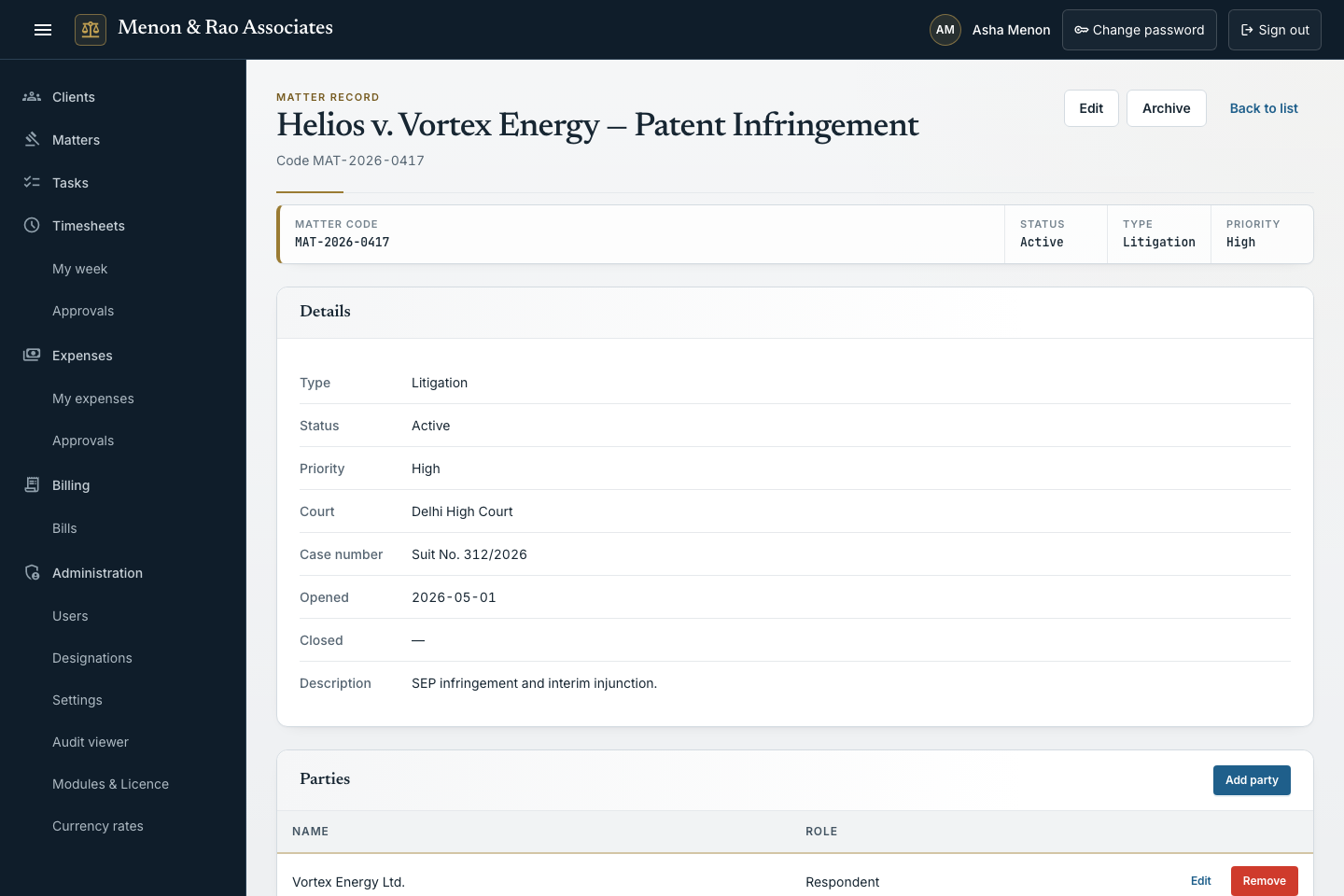
Court, case number, opposing party, hearing dates and matter type are fields, not free text in a description. Status and priority lists are managed by the firm, because one firm’s "under advice" is another’s "opinion pending".
Software that can be made to work in India is not the same as software designed for it.
every Indian convention in this system is a setting
Why private deployment matters more here
Confidentiality is not a settings toggle.
Client confidence is a professional obligation, not a preference, and for many mandates — regulatory work, arbitrations, matters against the state — the client will ask where the information sits and who else can reach it.
Every AntChambers customer is separate: a dedicated application stack, database, document store and backup boundary for one firm. AntChambers manages service health, updates and subscription status without placing your matters in a shared tenant database or pooling documents with another practice.
The practical answer to "where is our data" becomes a deployment and backup boundary written into the order and security schedule.
What firms move away from
Coming from Excel, or from something older.
Most firms arriving here are running weekly timesheets in Excel and building bills in Word from a template that has been copied for years, or an older system that was never designed for GST and cannot be changed.
Standard setup includes one template-based import of up to 1,000 combined client and matter records, initial settings and two one-hour remote training sessions. Historical time, bills, opening balances, document archives, legacy extraction and data cleanup are scoped and quoted separately before work begins.
Questions this raises
Straight answers.
Is AntChambers made in India?
Yes. It is built in India for Indian firms, which is why GST treatment, TDS withholding, financial-year numbering and the Indian digit grouping are part of the product rather than a localisation pack bolted on afterwards.
Our data cannot leave India. Is that a problem?
The standard managed offer keeps firm data in India. The application, document and backup locations are recorded in the order and security schedule before go-live.
We are not GST registered yet. Does that break billing?
No. GST registration is an installation-level switch. Turn it off and the GSTIN fields disappear, invoices are issued without tax lines, and the invoice heading changes to match. A later change applies to future billing; it does not rewrite finalised invoices. Confirm the correct tax configuration with your adviser.
Do you support firms with offices in more than one state?
The standard subscription covers one legal entity and one production installation. Confirm your office locations and invoicing registrations during evaluation. Multiple entities or separate billing installations need a scoped quote; per-client tax treatment alone does not establish that fit.
Can we bill foreign clients?
Yes. Engagements can be billed in another currency with export treatment applied, and consolidated back to the firm’s base currency for reporting through the exchange-rate service.
Where to read next
Related
- GST invoicing for law firms
SAC codes, reverse charge, export and exempt supply.
- Billing and fee notes
Terms of engagement through to receipts.
- Deployment and security
Keeping every firm in its own managed boundary.
See how it fits your practice
A working demo takes about forty minutes. We use sample or anonymised matters, timesheets and fee notes to walk through your workflow. Please do not share confidential client information.